Tuesday, 21 April 2015

Ashkan Honarvar


Ashkan Honarvar is a collage artist from the Netherlands, who depicts an undeniable, unavoidable beauty by accepting the darker sides of human nature. He tries to avoid digital collage works.
I actually found this artist in a fashion magazine (from an advert of eyewear that he created).
What I really like about his work is that he creates his work out of images from history and modern fashion magazines. I also enjoy the way that all of his collages are highly layered and all created by hand. Some of the other artists that I have looked at during this project have used digital imagery and collage techniques, however that is not something I want in my own work as I prefer to create the collages by hand.


Raoul Hausmann


Raoul Hausmann (1889-1971) was an Austrian artist and writer. And one of the key figures in Berlin Dada, his experimental photographic collages, sound poetry and institutional critiques would have profound influence on the European Avant-Garde in the after math of World War 1. He created work out of everyday/found imagery and lettering.


Richard Hamiton


Richard Hamilton (1922-2011), was an English painter and collage artist. 1950s-60s - His early work was influenced by D'Ary Wentworth Thompson' 1917 text 'On growth and form.


The collage above is Hamilton's most famous and most known piece entitled 'Just what is it that makes todays' homes so different, so appealing?' - This collage is made up of consumer products and recognizable images of the time. This image was the first piece of 'Pop Art' to achieve iconic status, (created in 1956). Hamilton subsequently created several works in which he reworked the subject and composition of the Pop Art collage, including a 1992 version, featuring a female bodybuilder.
I already knew of Richard Hamilton's work before I started this project, as I had looked at his work during past projects. However I hadn't really considered looking at his work at all for this project, until I found an article about his work in one of the fashion magazines, when I was looking for images to collage with.   

Hannah Hoch

 
Hannah Hoch (1889-1978) was a German Dada artist, she was best know for her work of the Weimar period, when she was one of the originators of Photomontage/collage. Her work is very recognizable and unique, and is often politically or socially themed.


The collage above entitled 'Bouquet of eyes' is probably my favourite piece of Hoch's work, In the collage you can see a number of eyes, arranged in such a manner to look like a bouquet of flowers, this is the main subject of the collage. The orange background colour portrays a relaxing mood, however this sense of ease is destroyed by the fact that all the eyes seem to be starring straight at the viewer all the time, as the eyes in the bouquet are focusing in all different directions, meaning you can not escape their gaze. Also some of the eyes in the bouquet are just the pupil and some are the full eye including the eye lid. this collage is said to engage with the ideas and themes of feminism and sexism in her work, as the eyes with the eye id included are very recognisable as male or female, however with the eyes that are just the pupil it is impossible to tell what gender the eye is.
I wanted to look at Hoch's work as inspiration for this project, as I really enjoy her collage style and her work deals with similar themes to the ones in my own work.
I also wanted to look at her work as I really wanted to try this style of collage, as I have never done this type of collage before and wanted to experiment with found images out of fashion magazines.     

Semester 2 - Project (Shamless, Unfamous and Obsessed)


During this project I plan to look at the theme of celebrity obsession and cultural ideas and standards of beauty. I plan to do this by creating a number of collages, made from images that I find in fashion magazines; such as Elle, vogue, etc.

Monday, 8 December 2014

Print: Project 5

 
Research:
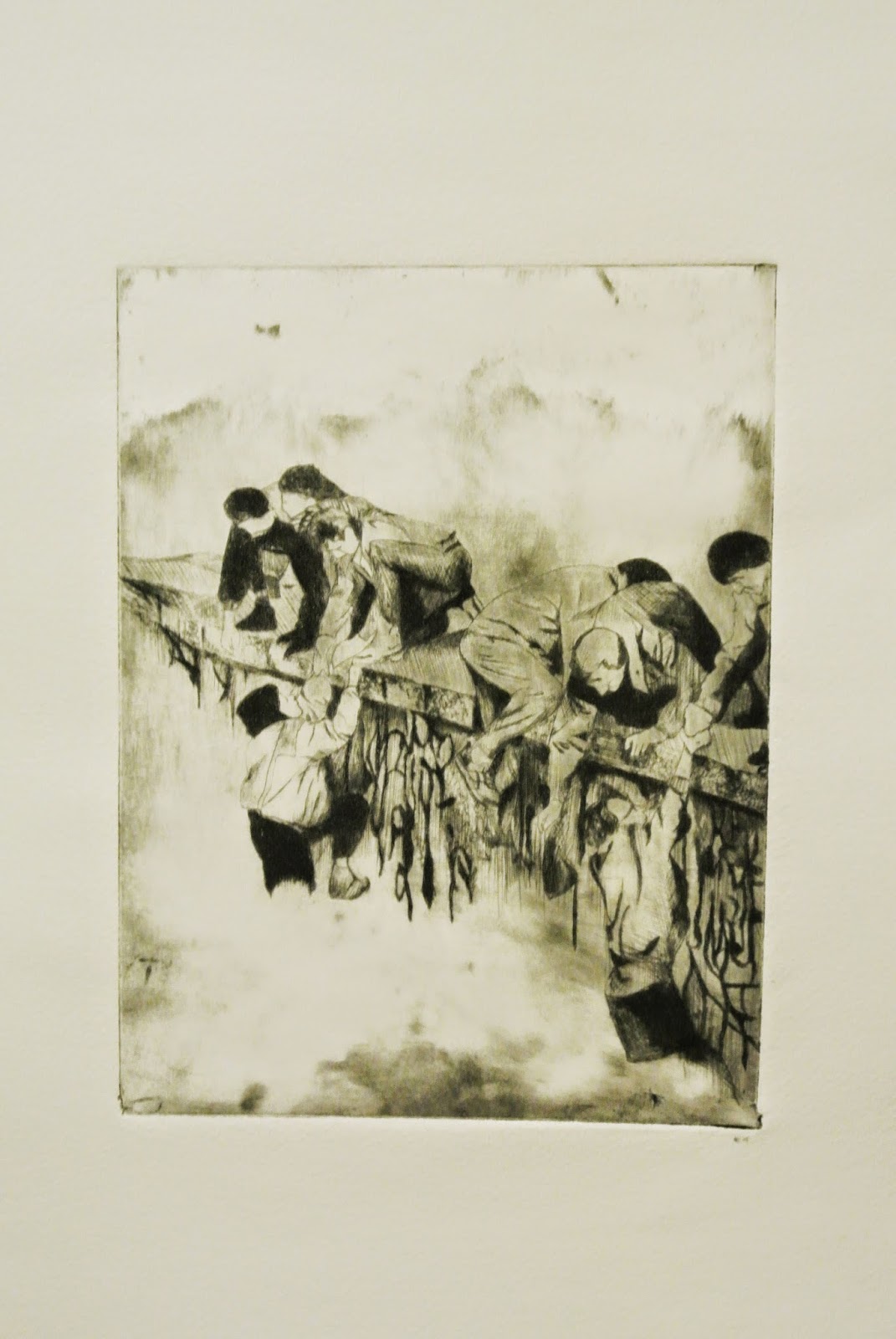
To start the print project we were asked to create 20 sketches that related to the theme of 'monument.` For this I researched the words monument and monumental, as a result of this I started researching monumental events in history, and this led me to articles and images of the Berlin wall. These images were a mixture between old photographs taken at the time and more recent photograph of the wall today. today parts of the Berlin wall are spread all over the world in countries such as The UK, Jamaica, India and South Korea to name a few. This interested me as I have seen some of the pieces that are in England, and that have been repainted. (some of the pieces were repainted with things that represent freedom and peace in the countries that they are located, some have remained the same and there are a couple of pieces in the RAF museum that have been painted with facts and the history of the wall.) I thought that some of these images would make great prints.
 
Printing:
The image that I used to create my dry point print was an old photograph of the Berlin wall when it was still up and when people first started to protest on top of it. I really liked this image and thought that it would translate well as a print.
After I had done my prints I decided that I wanted to incorporate some images of how some of the pieces looked today, I decided that I would collage and paint over the top of some of the prints to make them look graffitied on, and to make them look more interesting. 
I think that my prints worked really well and I really enjoyed making them, as dry point is one of my favourite techniques. I feel that to develop these prints further I would like to created more and develop the graffiti idea by using actual spray paint and stencils to create the images over the top, instead to just normal acrylic paint, to make it feel more realistic and add a different kind of mark and texture.   


Wednesday, 3 December 2014

Joseph Mallord William Turner


"Born London ,1775, died London, 1851. Turner was the most original and imaginative figure in the history of English landscape painting." (Andrew Graham-Dixon, Art the definitive visual guide, 2008, star standard industries, Singapore)
  • JMW Turner-Snowstorm: Hannibal crossing the alps, 1812 (forceful) - trying to show that nature is so powerful and that people are quite insignificant. Turner became obsessed with light and nature, reviving myths in a modern story.
Quotes;
  • "Every time I look in the mirror I see a gargoyle" - Timothy Spall, Quoting Turner.
  • "I didn't paint... to be understood I wish to show what such a scene was like" - Turner.
  •  "Atmosphere is my style" - Turner.
  • "Indistinctness is my fault" - Turner.

  • "The motif is unimportant to me, what I want  to reproduce is what stands between the motif and me." - Monet.

Turner-War: The exile and the rock limpet (1842)

Turner-The Thames above Waterloo Bridge (1830-1835)

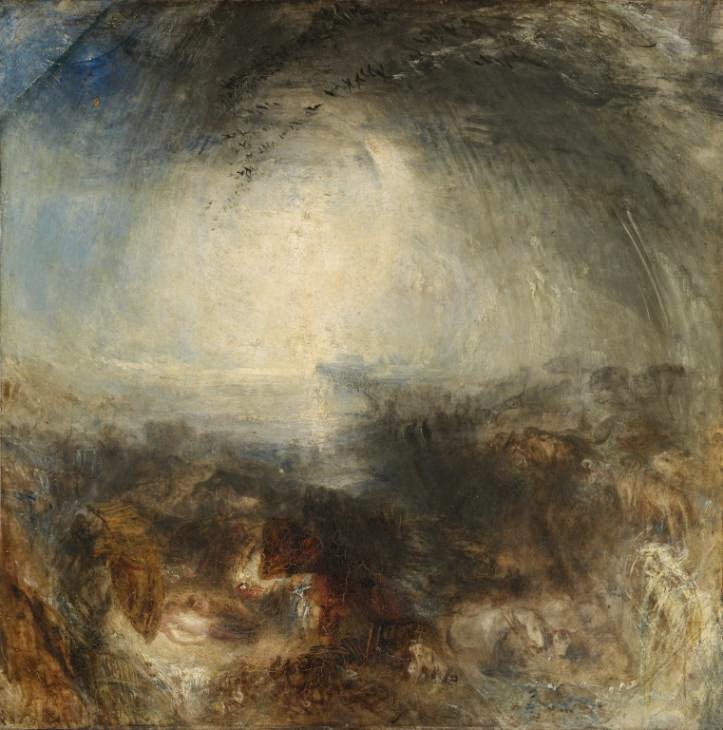
Turner-Shade and darkness: The evening of the deluge (1843)

Turner-Fire at the grand storehouse of the tower of London (1841) 

Turner-Light and colour - Goeth's theory (1843)

Turner-Peace Burial at sea (1842)

Turner-Rough sea (1840-1845)

Turner-Colour trails (1791)

Turner-A tree, with a line of trees beyond